
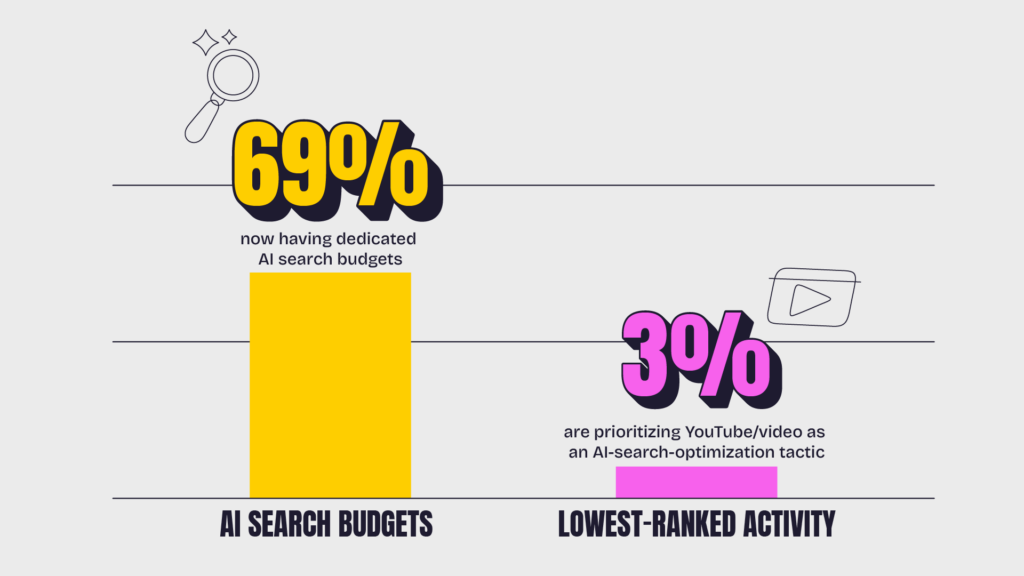
Quick Answer: AI engines like ChatGPT, Google AI Overviews, and AI Mode already cite and summarize video transcripts as source material. That’s not a future capability, it’s happening now. Yet a 2026 industry survey found only 3% of SEO professionals are using video for AI search optimization, even though 69% now have dedicated AI-search budgets, up from 38% last year. Real demand from AI engines. Almost no supply from marketers. That gap won’t stay open forever, and closing it is exactly what Piehole’s SCALE service does best.
Everyone’s racing to fix the same things. Crawl-ability. Schema. Content restructuring. Meanwhile, the channel AI engines are already pulling from, video, sits almost untouched.
That’s not a coincidence. It’s a capacity problem. Video takes more to produce than a technical audit or a content rewrite: scripting, filming, editing, transcribing, structuring for retrieval. Most teams know they should be doing it. Almost none of them have the bandwidth to ship it.
Which means video is one of the more open opportunities left in AI search right now.
That’s the short answer, but here’s why it’s true and how you can benefit from it now.
Why this is an opportunity, not a warning sign
Aleyda Solis’s SEOFOMO “State of AI Search Optimization Report 2026 Edition” surveyed 171 SEO and marketing professionals across 36 countries between August 17–27, 2026. Read the numbers in the right order, and they don’t describe a channel that’s failing, they describe a channel that’s wide open.
First: budget has arrived. 69% of respondents now have a dedicated AI search optimization budget, up from 38% in 2025 an increase of over 30 points in a single year. 61% say that investment grew during 2026, and only 1% saw it cut. This is no longer a discretionary experiment; it’s a funded line item at most organizations doing this work seriously.
Second, and this is the part that matters most: almost none of that budget is going to video, despite video already being a channel AI engines cite from. When asked which AI search optimization activities they’re currently implementing, only 3% of respondents pointed to “increasing visibility through YouTube/video” (21 of 171 respondents). Compare that to the activities eating the lion’s share of attention: improving technical crawl-ability (13%), expanding content to cover more topics (13%), restructuring content for retrieval (12%), and strengthening brand/entity signals (12%). Video sits near the very bottom of a fourteen-item list, just barely ahead of Reddit/forums engagement (2%). In other words: everyone is competing hard for the same technical and content tactics, and almost nobody is competing for video at all, which means video is one of the more open opportunities left in AI search right now.
It gets more striking when you look at impact, not just activity. Respondents were also asked which three tactics delivered the most meaningful positive results. Video scored just 1% there, six people, out of 171, credited it as one of their top three drivers of AI search visibility. Every other major content tactic, content expansion, crawl-ability, restructuring, brand signals scored between 9% and 18% on that same question. That’s not evidence video underperforms; the same survey shows almost nobody has tried it at scale, so there’s very little data on impact either way. Low usage plus low measured impact is what you’d expect from a channel nobody has seriously tested yet, not from one that’s been tried and found wanting.
Put those two numbers together and you get a genuine market inefficiency: the industry has decided, almost unanimously, that video isn’t worth the effort, at exactly the moment competitive pressure in every other channel (schema, crawl-ability, content restructuring) is intensifying because everyone is doing it at once.
Why Video Gets Left Out of AI Search Strategy
This isn’t because video doesn’t work for AI search, it’s that video is harder to execute than the alternatives on this list. Most marketing teams still think about video the way they always have: as a brand asset, a homepage hero, a sales-enablement tool. Something people watch, not something a search engine can use.
Video requires production: scripting, filming or screen-recording, editing. But the assets that are critical for AI visibility are the ones that come after, accurate transcription and structuring of that transcript so retrieval systems can parse it.
For web discovery, transcripts, captions and supporting written content give search and AI systems far more crawl-able context about what a video contains. A video published with a full, accurate transcript and clear supporting text becomes something an AI engine can draw from and potentially cite. A video with no transcript or context around it is much harder for those systems to understand, no matter how good the video itself is.
That’s the disconnect. Companies keep making videos. Most just aren’t building the supporting content that helps AI search systems understand it because almost nobody in the industry is treating video as part of their AI search strategy yet.
What Makes Video Easier for AI Search to Understand
This isn’t a call to make more videos. It’s a call to build the content around your video differently:
- A full, accurate transcript: published alongside the video, not buried in a closed-caption file
- Structured supporting text: a summary, key takeaways, or headers that mirror what you’d put in a well-optimized blog post
- Descriptive metadata and, where relevant, schema markup: useful for helping search engines understand what a video is about, even though it isn’t a guaranteed ranking factor for AI search on its own
- Content built to answer a specific question: the same way a good blog post does, rather than generic brand messaging
This is a production approach most video vendors and most in-house teams haven’t built into their process yet, simply because almost nobody has been asking for it. That’s exactly why it’s a competitive opening right now
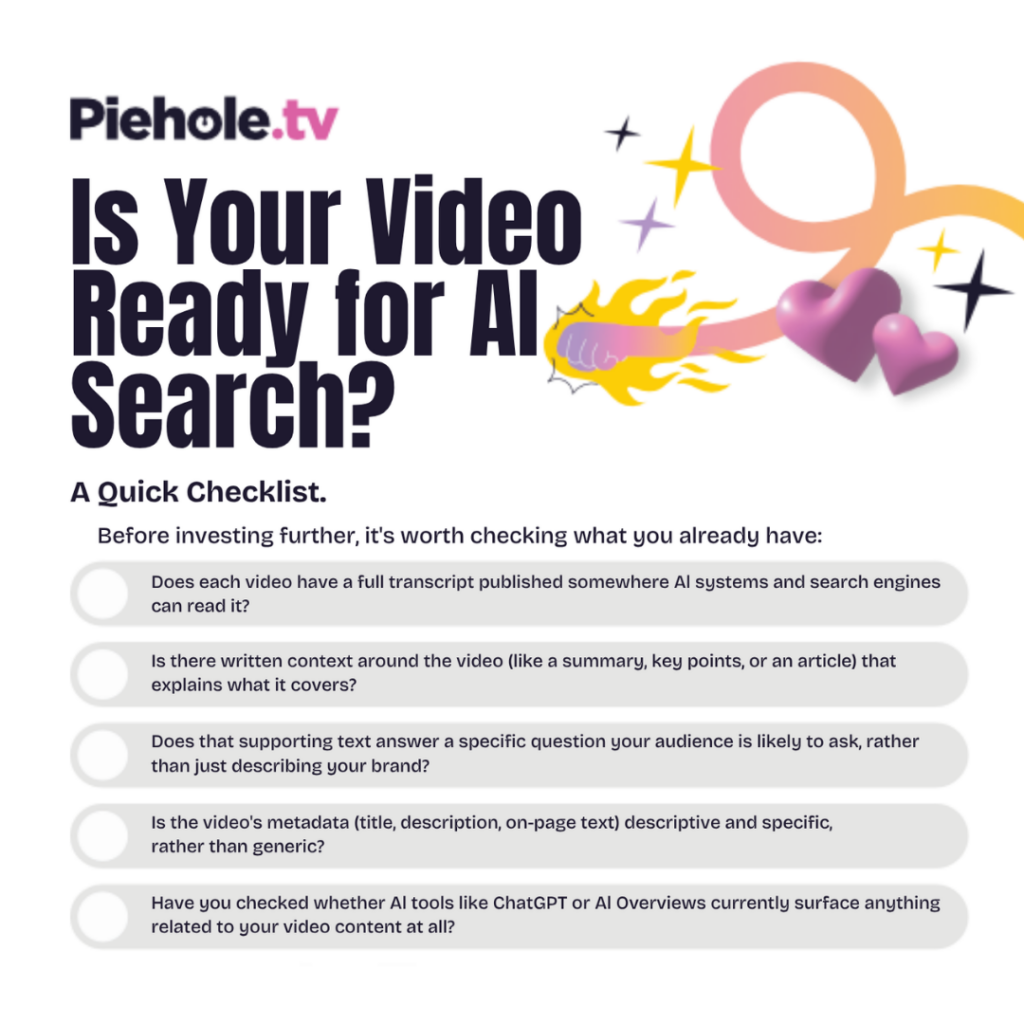
Is Your Video Ready for AI Search? A Quick Checklist
Before investing further, it’s worth checking what you already have:
- Does each video have a full, accurate transcript published somewhere AI systems and search engines can read it, not just embedded as closed captions?
- Is there written context around the video (a summary, key points, or an article) that explains what it covers?
- Does that supporting text answer a specific question your audience is likely to ask, rather than just describing your brand?
- Is the video’s metadata (title, description, on-page text) descriptive and specific, rather than generic?
- Have you checked whether AI tools like ChatGPT or AI Overviews currently surface anything related to your video content at all?
If most of these are unchecked, that’s not a failure, it just means there’s a clear next step available, and very few competitors have taken it yet.
The Fix: Video Built for AI Citation, By People Who Know Video
This is exactly the gap Piehole.tv is built to close and it’s not theoretical. When VOGSY, a global ERP company, came to us with a goal of increasing LLM visibility through their content, we built an ongoing content engine of social posts, YouTube videos, and customer testimonials designed to be understood by both people and AI systems.
The results, per VOGSY’s own account: after we launched the content engine, website traffic that had been declining due to the rise of generative AI tools like ChatGPT and Gemini didn’t just recover, it doubled. Social visibility grew 100-fold from a standing start. That’s what happens when content is built with AI visibility in mind from day one, not as an afterthought, and it’s the same approach we’re applying to video.
For teams that don’t just need one project but ongoing execution, someone to actually get this shipped alongside everything else already on the marketing plate that’s what our SCALE model is for. SCALE plugs Piehole in as an always-on senior marketing team across video, content, design, and campaigns, so this doesn’t become one more thing your stretched team has to squeeze in. You get the output of a bigger team, without the overhead of building one.

FAQ’s
Video can help, but mainly through the text built around it, a full transcript and supporting written content. For web discovery, transcripts, captions and supporting written content give search and AI systems far more crawl-able context about what a video contains, so a video with no transcript or context is much harder for them to surface, no matter how good the video itself is.
A 2026 survey of 171 SEO and marketing professionals (Aleyda Solis, SEOFOMO) found that only 3% are prioritizing video as an AI search optimization tactic, one of the lowest-ranked activities in the survey. This is largely because most teams still treat video as a brand or sales-enablement asset rather than a search-optimized content format, and because video takes more production capacity to execute than tactics like technical SEO or content restructuring.
A complete, accurate transcript, structured supporting text like a summary or key takeaways, and descriptive metadata all help. Schema markup can also support this by helping search engines understand what a video is about, though it isn’t a guaranteed AI-search ranking factor on its own.
There’s no fixed industry benchmark yet, since so few companies are doing this. In practice, many teams don’t need a new budget; they can redirect a portion of AI-search budget they already have toward adding transcripts and supporting content to videos they’re already producing.
Likely both. Right now, video is one of the least competitive areas in AI search, since so few companies have adapted it. Over time, as more marketers extend their AI search efforts beyond blog content, video is likely to become a more standard part of that work.
Not necessarily. Existing videos can often be made easier for AI search to understand by adding a full transcript and supporting summary text without re-shooting anything. New video is a good opportunity to build this in from the start, but it’s not a requirement to get going.
YouTube SEO focuses on signals like watch time, titles, and platform-specific metadata to rank within YouTube’s own system. AI search optimization focuses on making a video’s content, its transcript and supporting text, understandable to AI engines like ChatGPT and Google AI Overviews, regardless of which platform the video lives on.
Most teams don’t know, because video is rarely included in AI-search visibility audits the way blog content is. Checking typically means testing relevant queries directly in ChatGPT, AI Overviews, and AI Mode to see whether your video content, or content derived from it, is being surfaced.
Final Thoughts
The gap here isn’t about budget, most teams already have some. It’s about where that budget is going. Video remains one of the less-developed parts of most AI-search strategies, while teams continue to focus heavily on written content, structured data and citations. That won’t stay true forever, but it’s true right now.
You likely already have the raw material for this: video you’ve produced, or plan to produce, that simply hasn’t been given the transcript and supporting content that would make it easier for AI search to understand. Closing that gap doesn’t require reinventing your video strategy, it requires treating the content around your video as seriously as you already treat your written content.
Not sure if your video content is even on AI search’s radar?
Piehole.tv can help you find out and fix it. Whether you need a single video built with AI visibility in mind, or ongoing execution across video, content, and campaigns through SCALE, we’ll help you turn this gap into your next opportunity.